4 Feb 2026
Love Casts out Fear

Podcast: Play in new window | Download
For 4 February 2026, Wednesday of week 4 in Ordinary Time, based on 1John 4:11-18
Dear friends, since God so loved us, we also ought to love one another. No one has ever seen God; but if we love one another, God lives in us and his love is made complete in us.
This is how we know that we live in him and he in us: He has given us of his Spirit. And we have seen and testify that the Father has sent his Son to be the Savior of the world. If anyone acknowledges that Jesus is the Son of God, God lives in them and they in God. And so we know and rely on the love God has for us.
God is love. Whoever lives in love lives in God, and God in them. This is how love is made complete among us so that we will have confidence on the day of judgment: In this world we are like Jesus. There is no fear in love. But perfect love drives out fear, because fear has to do with punishment. The one who fears is not made perfect in love.
Scripture passage from the New Revised Standard Version Bible: Catholic Edition, copyright 1989, 1993, Division of Christian Education of the National Council of the Churches of Christ in the United States of America. Used by permission. All rights reserved.
 General editor:
04 February 2026 @ 9:47 pm
Dear Erika,
Today I had the joy, once again—as so often—of listening to you with great profit. I have long wanted you to know that your address at the Preaching Congress in Cologne years ago has stayed with me ever since. At several funerals, I have spoken about you and that sermon in this way:
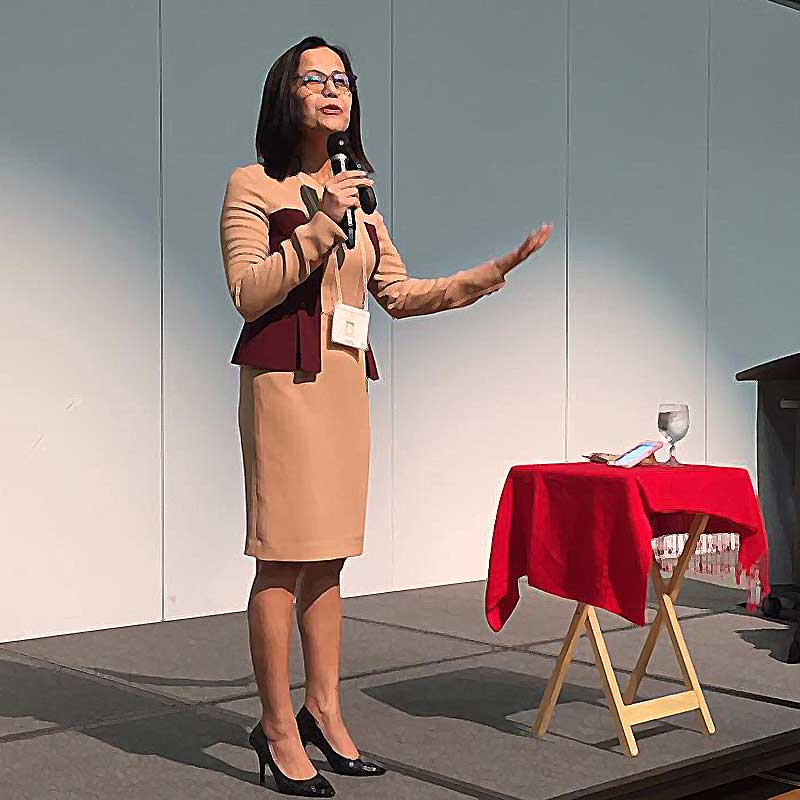
Years ago, I took part in an international theological conference. Among the speakers were a considerable number of academic luminaries. I remember the content of their lectures only in the most rudimentary way, and only with my mind. What has remained stored in my heart, however, is the contribution of a small, delicate woman from the Philippines: Mary Erika Bolanos. On one of the conference days, she gave the address at morning prayer.
I can still see her standing there, a spoon raised in her hand. And then she told us about an old woman from her hometown. In her will, this woman had stipulated: “When I die, place a spoon in my grave. From childhood on, the spoon has been a sign of hope for me. Whenever we were invited to my aunt’s house for a meal, once the main course had been eaten and it was time to move into the living room, she would take her spoon, lift it high into the air, and say: Take the spoon with you, for the best is still to come. And she was right—nowhere else were there desserts like the ones at that aunt’s house. That is why a spoon belongs in my grave. It shall tell me, right there in that place: The best is still to come.”
I thought you should know that.
With a warm Dominican hug
Fr. Manuel Merten OP